
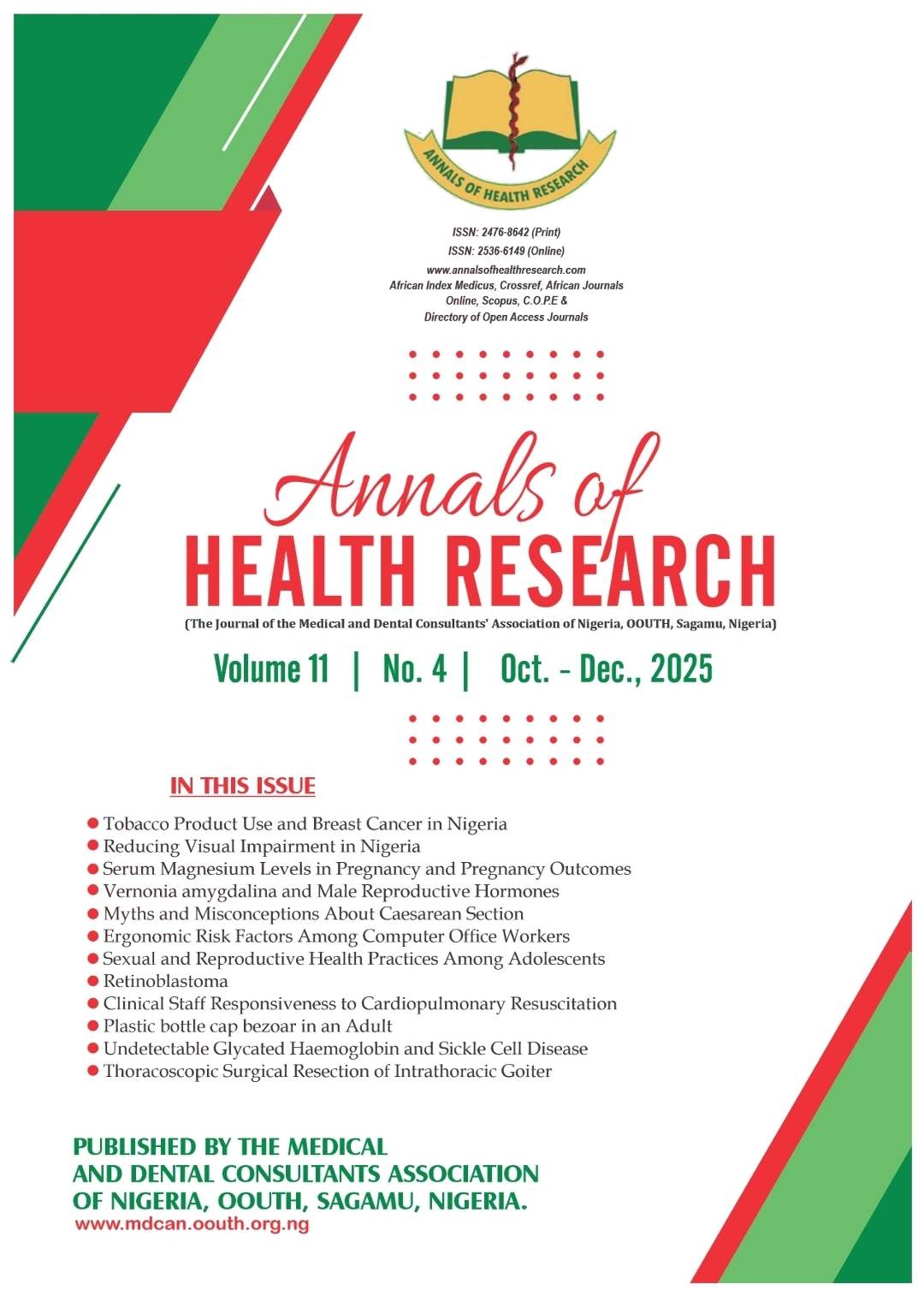
Clinical Staff Responsiveness to Cardiopulmonary Resuscitation and Basic Life Support Practices in the Winneba Municipal Hospital, Ghana
DOI:
https://doi.org/10.30442/ahr.1104-09-307Keywords:
Basic Life Support, Cardiac arrest, Cardiopulmonary resuscitation, Defibrillators, Emergency Cardiac CareAbstract
Background: CPR is essential for survival after a Sudden Cardiac Arrest. However, many health workers in Ghana are still not adequately trained or equipped. This gap frequently contributes to delayed or absence of CPR interventions, which in turn contributes to mortality.
Objective: To assess clinical staff responsiveness to CPR and Basic Life Support Practices in the Winneba Municipal Hospital, Ghana.
Methods: The study employed a cross-sectional design and utilised a sequential explanatory mixed-methods strategy. It involved surveying all eligible in-patient clinical staff quantitatively, while intentionally selecting five unit heads for deeper qualitative data collection.
Results: The study revealed that 87.2% of clinical staff had recently participated in CPR and 82.1% had taken an active role, but only 3.9% held valid BLS certification. CPR outcomes were poor, with an 88.5% fatality rate. Only 10% of professionals demonstrated proficiency in defibrillation. Multivariate analysis confirmed that formal BLS training (OR = 1.448, p = 0.016) and hands-on practice (OR = 1.104, p = 0.038) significantly enhanced the likelihood of an effective CPR response. In contrast, unit assignment (OR = 0.342, p = 0.003) reduced the likelihood of success.
Conclusions: While clinical staff may show strong commitment to CPR and possess strong hands-only CPR skills, only a few hold formal BLS certification, and significant gaps remain in equipment use, particularly with defibrillators. Formal training and frequent practice may significantly improve outcomes, but disparities in unit placement, limited equipment, and lack of advanced training contribute to high CPR mortality.
References
1. Association, American Heart. Highlights of the 2015 American Heart Association Guidelines Update for CPR and ECC, Dallas. [Online]. 2015 [cited 2024 20 April. Available from: https://cpr.heart.org.
2. Pallin DJ, Brown T, Doninno MW. Cardiac arrest and cardiopulmonary resuscitation. Emergency Med Clin North Am 2023;41:407–421.
3. Hardman JG. Oxford Textbook of Anaesthesia (Editors). 5th Ed. Oxford: Oxford University Press; 2017.
4. Ministry of Health, Ghana. Accident and Emergency Services Policy Guidelines Accra: MOH; 2011.
5. Smith L, Brown T. Basic Life Support for Health Care Providers Dallas: American Heart Association; 2017.
6. American Heart Association. Highlights of the 2020 American Heart Association Guidelines for CPR and ECC Dallas: AHA; 2020.
7. Osei-Ampofo M, Sefordzi K, Jambo A, Oduro G. Emergency Medical Services and Cardiopulmonary Resuscitation Practices in Ghana. Ghana Med J 2013;2:61–71.
8. Sutton RM, Duff JP, Atkins DL. Pediatric cardiopulmonary resuscitation quality and beyond: The importance of responsiveness. Current Opinion Crit Care 2021;27:272–279.
9. Rajeswaran L, Ehlers V. Cardiopulmonary resuscitation knowledge and skills of registered nurses in Botswana. Curationis 2013;37:1–8.
10. Mafolo UJ. Determinants of patient-centred emergency nursing care in primary hospitals at Tutume and North-East districts, Botswana: Doctoral dissertation, The University of Zambia; 2025.
11. Olajumoke T, Afolayan JA, Adesina CO, Adebanjo A, Bisiriyu LA. An Assessment of Knowledge and Practice of Cardiopulmonary Resuscitation among Nurses in Nigeria. Afr Health Sci 2012; 4:654–660
12. Joy News. Former Vice President Amissah-Arthur dies after collapsing at the gym. [Joy Online]. 2018 [cited 2024 15 April. Available from: https://www.myjoyonline.com
13. Hoops K, Bedner A, Kemper E, Aksamit D, O’Brien C, Johnson MK, et al. Demand for cardiopulmonary resuscitation and bleeding control skills training in an urban region: a feasibility review of a community engagement effort. Frontiers Public Health 2025;13:1339215.
14. Kaggwa MM, Najjuka SM, Bongomin F, Mamun MA, Griffiths MD. Prevalence of depression in Uganda: A systematic review and meta-analysis. PLoS ONE 2022;17:e0276552.
15. Gebreegziabher Gebremedhn E, Berhe Gebregergs G, Anderson BB, Nagaratnam V. Attitude and skill levels of graduate health professionals in performing cardiopulmonary resuscitation. Adv Med Educ Pract 2017;8:43-50.
16. Alzahrani AM, Hakami A, AlHadi A, Al-Maflehi N, Aljawadi MH, Alotaibi RM, et al. The effectiveness of mindfulness training in improving medical students’ stress, depression, and anxiety. PLoS ONE. 2023;18:e0293539.
17. Bryman A. Social research methods. Oxford University Press, 2016.
18. Mogomotsi M, Rajeswaran L, Collins-McNeil J, Sjetne IS, Tshiamo WB. Assessment of nurses’ cardiopulmonary resuscitation knowledge and skills within three district hospitals in Botswana. Afr J Primary Health Care Family Med 2022;14:16-33.
19. Greif R, Bhanji F, Bigham BL, Bray J, Breckwoldt J, Cheng A, et al. Education, implementation, and teams: 2020 international consensus on cardiopulmonary resuscitation and emergency cardiovascular care science with treatment recommendations. Circulation 2020;142:S222-S283.
20. World Health Organisation. Emergency care system framework: Consensus-based guidance and practical tools for planning, developing and strengthening first-line emergency care services. World Health Organisation, 2021.
21. Ocen E, Ario C, Nakanwagi E. Effectiveness of simulation-based education of adult BLS-CPR on nursing students’ skills and knowledge acquisition. Adv Med Educ Pract 2022;16:663–673.
22. Gräsner JT, Wnent J, Herlitz J, Perkins GD, Lefering R, Tjelmeland I, et al. Survival after out-of-hospital cardiac arrest in Europe: Results of the EuReCa TWO study. Resuscitation 2020;148:218-226.
23. Barash PG. Clinical Anesthesia. 7th Ed. Philadelphia: Lippincott Williams & Wilkins; 2013.
24. Turley JP TJDG. Assessing Health Professionals’ Basic Life Support Competency: A Simulation Approach. Acad Med 2005;80:117–120.
25. Odoro FT. Evaluation of Clinical Training of Emergency Response Nurses in Ghana. Int J Nurs Educ 2015;7: 1–7.
Downloads
Published
Issue
Section
License
Copyright (c) 2025 Annals of Health Research (The Journal of the Medical and Dental Consultants Association of Nigeria, OOUTH, Sagamu, Nigeria)

This work is licensed under a Creative Commons Attribution-NonCommercial 4.0 International License.
The articles and other materials published in the Annals of Health Research are protected by the Nigerian Copyright laws. The journal owns the copyright over every article, scientific and intellectual materials published in it. However, the journal grants all authors, users and researchers access to the materials published in the journal with the permission to copy, use and distribute the materials contained therein only for academic, scientific and non-commercial purposes.
